
The list to look for on your vendor deck
Count the places your inventory feed goes. One common layout: a display and retargeting vendor takes the whole feed; a social vendor takes it for Meta, where automotive inventory ads require a vehicle catalog feed with make, model, price and mileage plus the Meta pixel sending vehicle views, and then retarget shoppers with the cars they viewed and similar cars, and prospect wider audiences as well (DataFeedWatch, 5 Steps You Need to Set Up Facebook Automotive Ads); a search vendor takes it for vehicle ads; sometimes a fourth takes the aged filter for a monthly special.
Now pick up last month's deck from each of them. Monthly budget, impressions, clicks, VDP views, leads, cost per lead. Read every page and look for a list of the VINs that were advertised, with dates and cost per VIN. If it is not there, the one question that would show you the overlap, which cars did all three of you run, cannot be answered from the paper you were given. A shopper who opened the page for your 40-day pickup on Tuesday can be retargeted by the display vendor, retargeted again on Meta, and shown the same truck on search. That is three payments for the same car in front of the same person, and without the VIN lists nothing on the three decks would show it.
The money at stake is not small. Franchised dealers spent $9.96 billion on advertising in 2025, $739 per new vehicle retailed, up $34 from 2024, and 74.9% of dealer ad spending in 2025 was digital media (NADA Data 2025 as reported by Dealership Guy News). A feed sent to three vendors is three copies of every car, and the digital share is where those copies are bought.
One car, one channel
Carumai is a VIN-level inventory operating system. It reads one live inventory feed, every VIN, new and used, and runs each car's advertising from there across Google, Meta, TikTok and Snapchat, with Amazon and paid Google Vehicle Listing Ads available as channels. One feed, four platforms describes the plumbing. The rule that matters for this article is simpler: a car that matches more than one active channel runs only in the channel with the highest budget. A car is never advertised twice.
That rule holds between the engine and the store's own rules as well. When a manager writes a manual channel in plain terms from a saved filter view, "60+ days on lot, new and used", picks platforms, sets a geography and a monthly budget, the vehicle count updates before the rule is turned on, and a car that also qualifies for the engine's pick still runs in one place. Manual channels are labelled as the dealer's rule, never as the engine's pick, and their spend is reported separately. Rules in plain words covers how a store writes one.
A car cannot receive automated advertising until it is ready: an allowed saleable status, a live vehicle page, the required photos, a public price, correct core data and the right store. A car that is not ready is shown as blocked with the exact reason and a link to fix it, and returns to the eligible pool on its own when the data is fixed. When an advertised car sells or becomes unavailable, its automated advertising stops, and the reason is recorded and shown on the car. So the car that was bought three times on three feeds is bought once on one, and the car that was not ready is not bought at all.
The list Carumai gives you instead
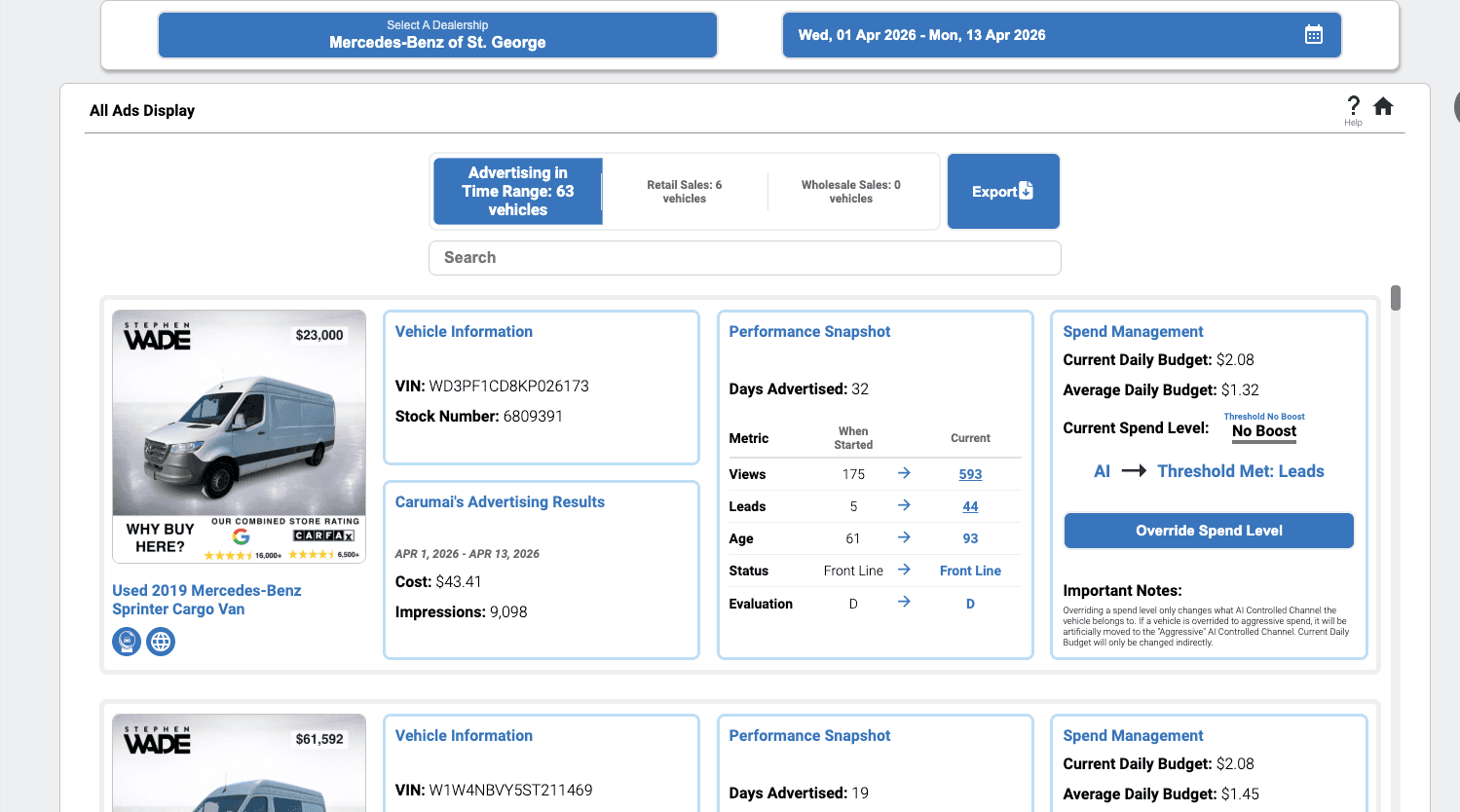
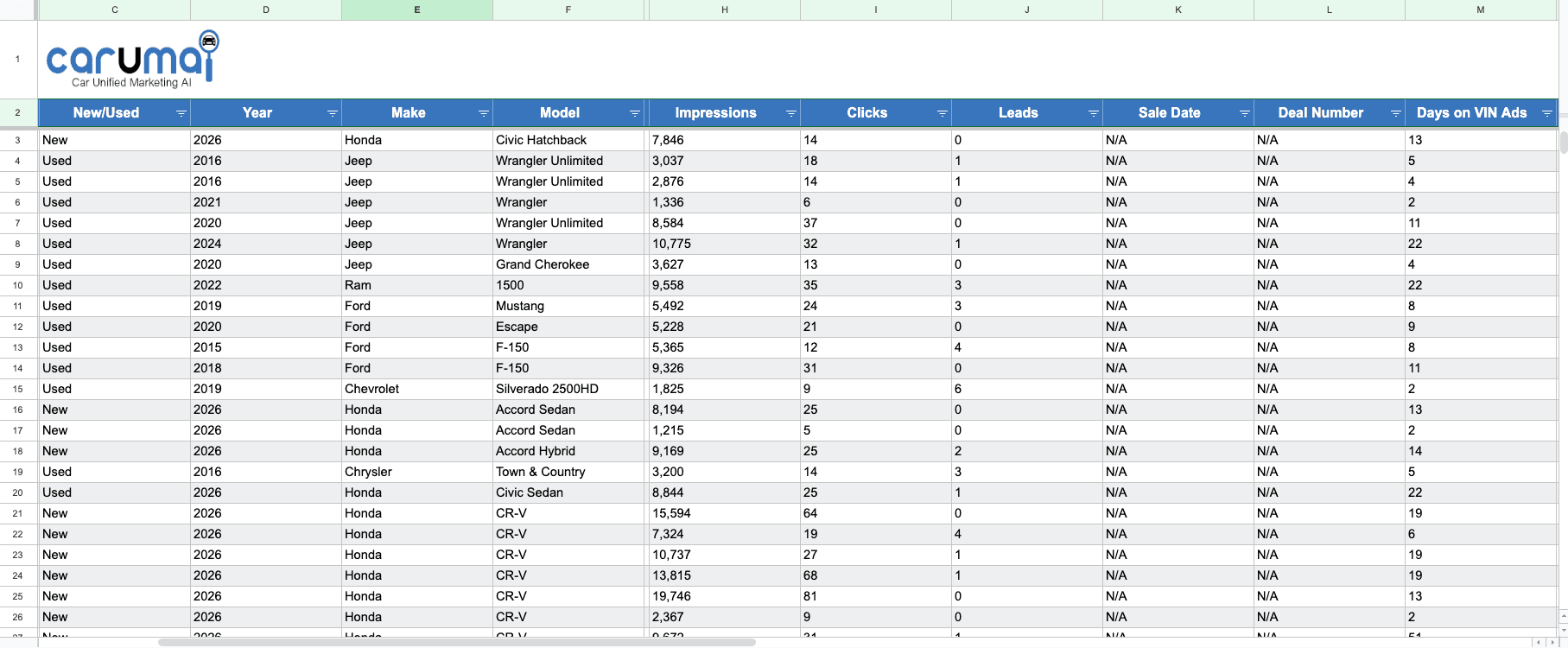
Every week, the Listed export names every car advertised that week with its cost, impressions and clicks, and the Delisted export names every advertised car that retail-sold that week with its sale date. The VIN Ads report, for any date range and store, shows how many VINs were advertised, when, on which platforms, at what support level, for how long, at what cost, and what happened to them: retail sale, wholesale exit or still in stock. Days advertised, cost, impressions and views are on every row, with views, leads and age at start versus now.
On the VIN card, the channel history shows every channel the car has run in, with start and end dates, beside the active channel, the support level, Carumai's recommendation and any override a manager has placed. The audit records every channel change, budget change, ad start and stop, so a manager can see why any car started, changed or stopped advertising. The overlap check you would do by hand from three vendor lists is a column on one screen.
The result for the GM is a bill that reads by car. Cost per car-week, with CPM and CPC beside it, is in Carumai's reporting for every store and every month, new and used stated separately, with the same definition each time.
What to do Monday
You can check the overlap this week without any new software. Ask each inventory advertising vendor for its advertised VIN list for last month: VIN, dates advertised, spend by VIN. Put the lists in one spreadsheet and match on VIN. Every VIN that appears on two lists is a car you bought twice; every VIN on three lists, three times. Then count the VINs on none of the lists, because those are the cars no vendor advertised while three invoices were paid. If a vendor cannot produce the list, that tells you something too: a vendor who cannot say which cars it advertised cannot say what any one car cost, or whether the 40-day pickup was ever shown to anyone.
Whatever the overlap turns out to be, you will know which cars your budget was on, which cars it was on twice, and which cars it never touched. If you want to see the single-channel version on your own inventory, bring one inventory export to a 20-minute demo and we will show you your zero-lead list and your coverage: book a 20-minute demo.
Frequently asked questions
How do you know if two ad vendors are advertising the same cars?
Ask each vendor for last month's advertised VIN list with dates and spend by VIN, put the lists in one spreadsheet and match on VIN. Any VIN on two lists was advertised twice. A vendor that cannot produce the list cannot tell you which cars it advertised or what each cost.
Can a car be advertised on Google and Meta at the same time with Carumai?
No. A car that matches more than one active channel runs only in the channel with the highest budget, whether the channels are the engine's picks or the store's own manual rules. The active channel and the full channel history, with start and end dates, are shown on the VIN card.
What does an inventory advertising vendor report show?
Check yours for monthly budget, impressions, clicks, VDP views, leads and cost per lead, then look for a list of the VINs advertised with cost per VIN. Carumai's weekly Listed export carries every advertised VIN with its cost, impressions and clicks, and the VIN Ads report adds platform, support level, days advertised and the car's outcome.
Sources
- DataFeedWatch, "5 Steps You Need to Set Up Facebook Automotive Ads" (Meta Automotive Inventory Ads overview). https://www.datafeedwatch.com/blog/facebook-automotive-ads
- NADA Data 2025 as reported by Dealership Guy News, "Dealer ad spend nears $10 billion as digital marketing dominates". https://news.dealershipguy.com/p/dealer-ad-spend-nears-10-billion-as-digital-marketing-dominates