
Used car managers and GMs: pull up your front line and count the cars with zero leads. That list is money sitting still on your lot, and your cost per lead report cannot see a single car on it.
The problem: the industry pays to hold cars nobody is looking at
Shoppers decide online, car by car. Cox Automotive's 2025 Car Buyer Journey study of 2,344 recent buyers found used car buyers spent 7 hours and 45 minutes researching online, and 77% of them used third-party sites. A car that is not in front of those shoppers does not get looked at.
Every day a car sits costs money. NCM Associates' 20 Group studies (2018) put the average daily holding cost at $37 per vehicle. That is $259 a week, per car, before anyone asks about it. And the industry carries a lot of cars: dealers held 2.18 million used vehicles at the start of February 2026, a 48-day supply, per Cox Automotive.
Dealers already spend heavily to advertise. NADA Data 2025 puts the average franchised dealership's advertising spend at $586,246 a year, or $739 for every new vehicle sold.
And the report most dealers judge that spend by cannot see the problem cars. A cost per lead divides an invoice by the leads it collected. A car with no leads adds nothing to the math, so it never shows up. The report can look fine while part of your lot sits with nobody asking about it.
Here is what that looked like at one seven-rooftop dealer group on September 1, 2026: 117 used cars and 141 new cars on the front line with zero leads. None of them appeared in any cost per lead number.
These are not always old cars. A car can be 10 days in stock and already getting passed over. Age is one clue. The real test is whether shoppers are looking at it.
How Carumai solves it: one car at a time, every day
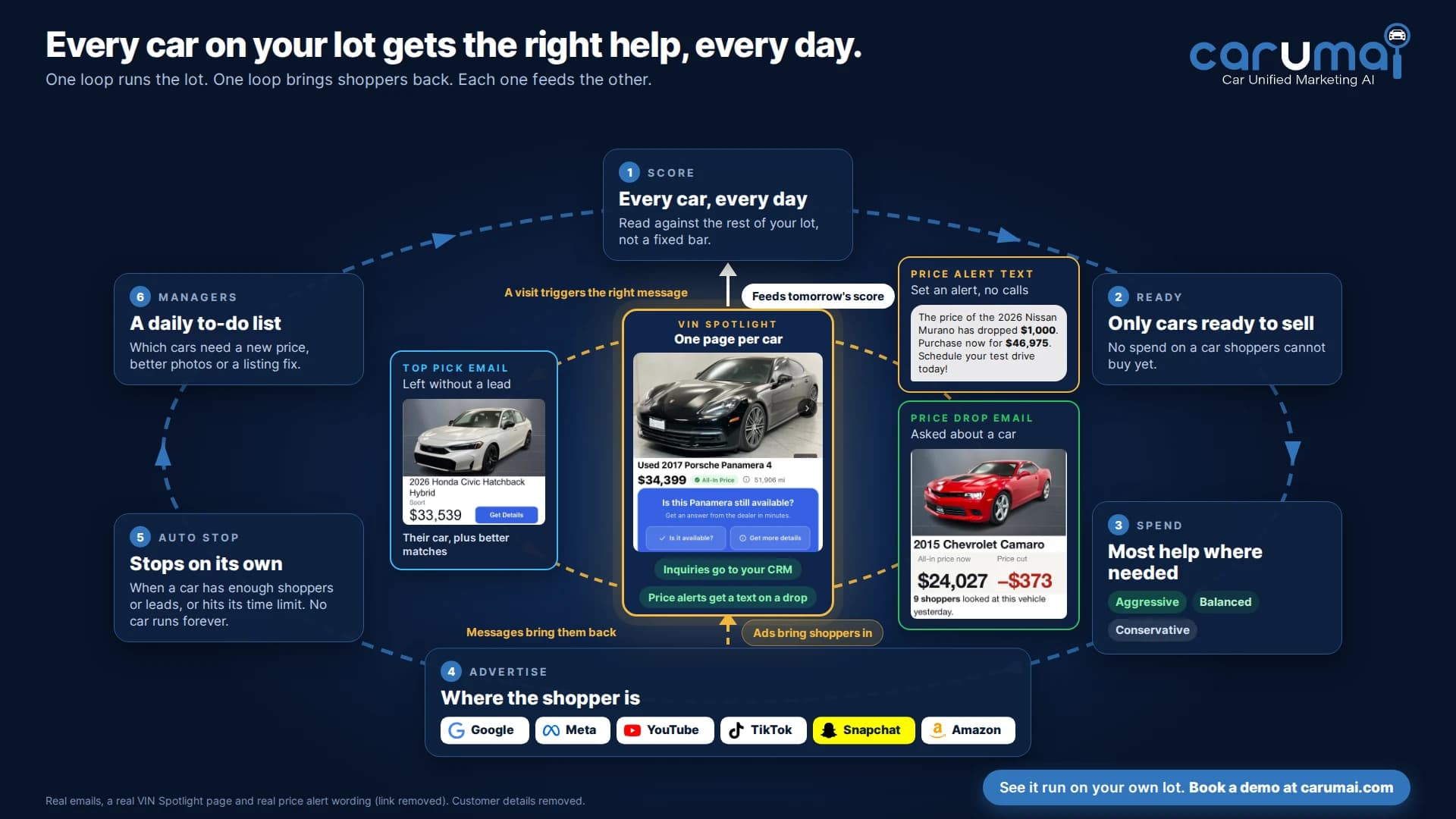
Carumai does not run a campaign and walk away. It runs a cycle. Every store's inventory is read again every morning, and every car goes through three steps.
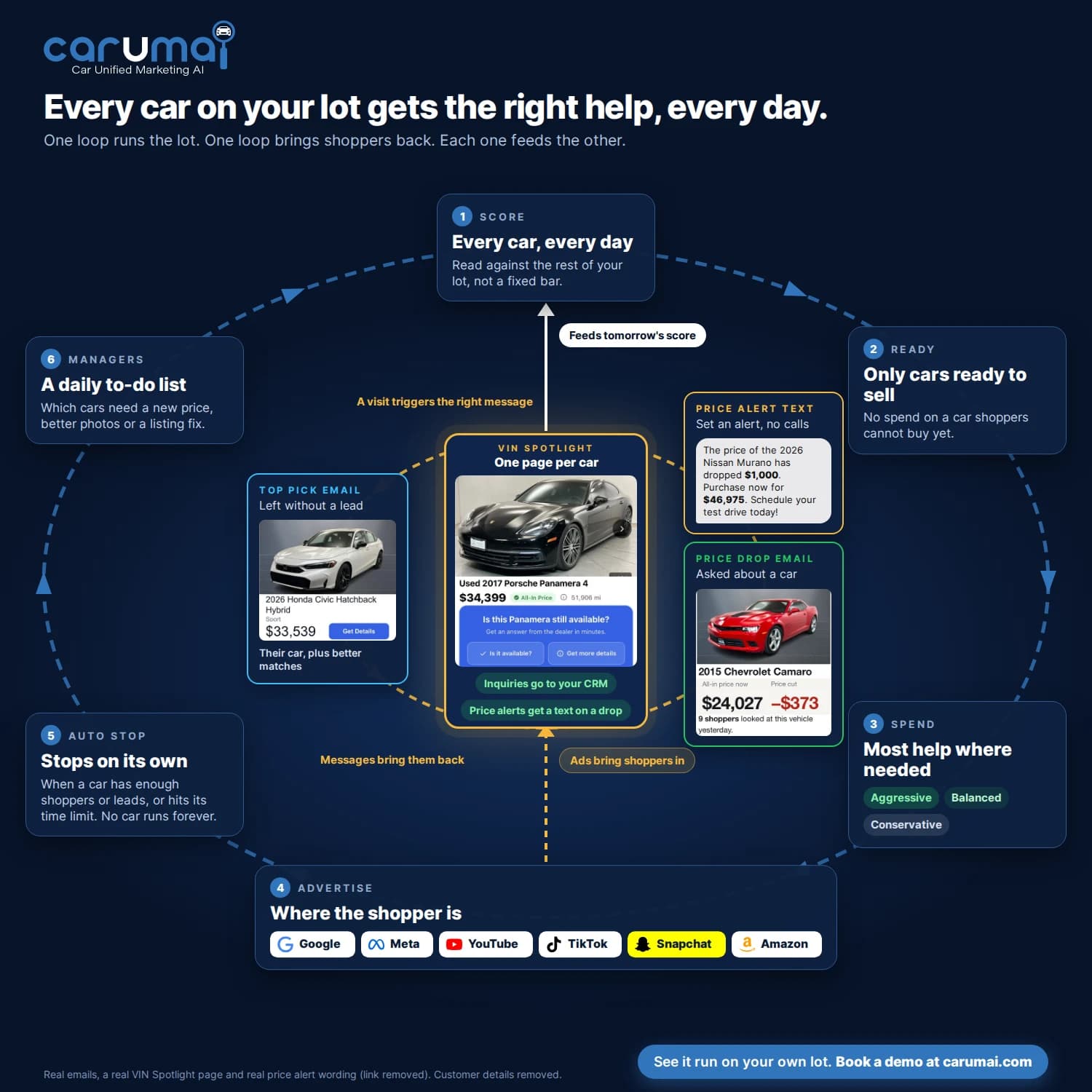
1. Select. Carumai picks the cars that need help. Carumai reads each car's own profile (Vehicle DNA) against how shoppers are reacting to it online: page views, active shoppers and leads. The cars falling behind get picked. The cars already drawing shoppers on their own are left alone.
Before a picked car spends a dollar, it has to be ready to show a shopper: 10 or more real photos, a public price, a live vehicle page, front-line status and a complete listing. A car that fails gets no ad money until it is fixed, and the fix list lands in the morning email.
2. Advertise everywhere. The car goes where the shoppers are.
- Google Standard ads, the workhorse. Broad audiences that drive the volume: new vehicle shoppers, used vehicle shoppers, people searching on auto sites, and local shoppers on local sites.
- Google Retargeting ads. Shoppers who viewed that exact car's page in the last 90 days see it again.
- Facebook and Instagram. Audiences built from your website pixel: shoppers who started a form, completed a form or took other actions on your site.
- YouTube, TikTok, Snapchat and more. The car shows up on the screens shoppers use.
3. Auto stop. Spending ends on a rule, not a guess. Carumai stops every car it picks at the first of these three:
- 50 active shoppers on the car;
- 2 leads on a new car, or 3 on a used car, while it is advertised;
- 31 days advertised. No car runs forever.
A stopped car stays off until a manager puts it back. Tomorrow morning the lot is read again and the next cars that need help are picked. Your managers stay in charge: if a manager overrides a car's spend, that decision is his and it holds until he changes it.
What you get
Your ad money goes to the cars that need it. Spend lands on the cars shoppers are passing over, not on the cars already drawing attention by themselves.
A price per car you can hold up against holding cost. In August 2026, the seven-rooftop group advertised 1,319 cars (813 used, 506 new) for $50,830: $15.14 per car-week on used and $13.51 on new. Put that beside the $37 per vehicle per day NCM's 20 Group studies (2018) reported, or $259 a week. A week of exposure on a stuck used car cost about 6% of what that car cost to sit for the same week.
A known price per click. The same group paid $1.10 per click on used cars and $0.96 on new. For context only: LocaliQ's 2026 benchmark of 2,001 automotive search campaigns puts the average search click at $3.13. The two are not like for like (a search click buys a shopper's question, an inventory click buys a look at one specific car).
Spending that stops on a rule. Carumai stops every car it picks at the first of the three rules, and a car a manager has overridden runs until he turns it off. And if a car qualifies for more than one of your channels, it runs only in the one with the highest budget, so you never pay twice for the same car.
More shoppers on the cars that had none. That is the whole purpose: more views and more leads on the cars that were getting neither. You do not take it on faith. The All Ads report shows every advertised car's page views and leads when its ads started against today, car by car.
A to-do list instead of a dashboard. Each store gets one email each morning, Carumai Daily. On October 1, 2026, one store opened it to 3 blocked cars, each missing photos and a live vehicle page; 10 aged cars with shopper demand; 45 leads needing follow-up across 38 vehicles; and 5 used cars with no price cut in 5 days and no new lead in 14. That is the morning meeting agenda, written before anyone gets to work. The weekly export a GM can read shows the files behind it.
Numbers you can check yourself. The Listed export shows every car advertised, with its cost, impressions, clicks and leads. Your controller can rebuild every Carumai figure in this article from Carumai's files. Leads stay where your people work them, in your CRM.
Schedule your demo now
Bring one inventory export to a 20-minute demo. We will show you your zero-lead list and how many of those cars have advertising behind them today. You leave with the list either way: book your 20-minute demo now.
Frequently asked questions
Is cost per lead a good way to measure inventory advertising?
Cost per lead fits search ads, where the click is the product. It cannot see a car with zero leads. Inventory ads are bought for one car, so they are measured by the car: cost per car-week, cost per click, and that car's views and leads.
Which cars does Carumai advertise?
The cars falling behind on shopper attention, picked fresh every morning from the whole lot. A car must be ready first: 10 or more real photos, a public price, a live vehicle page, front-line status and a complete listing.
When does Carumai stop advertising a car?
At the first of three: 50 active shoppers on the car, 2 leads on a new car or 3 on a used car while it is advertised, or 31 days advertised. A stopped car stays off until a manager puts it back.
Sources
- Cox Automotive, "2025 Cox Automotive Car Buyer Journey Study Summary" (2,344 buyers; fieldwork Aug. 6 to Sept. 5, 2025). https://www.coxautoinc.com/wp-content/uploads/2026/03/2025-Cox-Automotive-Car-Buyer-Journey-Study-Summary.pdf
- Cox Automotive, "Used-Vehicle Inventory, January 2026," Feb. 13, 2026. https://www.coxautoinc.com/insights-hub/used-vehicle-inventory-january-2026/
- NCM Associates 20 Group studies, daily holding cost of $37 per vehicle, as reported by Rapid Recon, "Holding Cost Killing Your Gross?", Dec. 18, 2018. https://rapidrecon.com/holding-cost-kill-your-gross/
- NADA Data 2025 (16,997 franchised dealerships), as reported by Inside Radio, "Turning Data Into Dollars: Key Insights From 2025 NADA Data," June 16, 2026. https://www.insideradio.com/free/turning-data-into-dollars-key-insights-from-2025-nada-data/article_660f3282-8150-47e8-bb69-c2f1d13127ce.html
- LocaliQ, "Automotive Search Advertising Benchmarks for 2026," May 6, 2026 (2,001 US search campaigns, October 1, 2024 to September 30, 2025). https://localiq.com/blog/automotive-search-advertising-benchmarks/
- Carumai figures: one seven-rooftop dealer group, August 2026 Carumai exports, Sep 1 and Oct 1, 2026 reads. Stop thresholds from Carumai's A-Star documentation.