The rule on one line
Open the filter behind your aged campaign and read the line it draws. An aging report that buckets cars at 0 to 30, 31 to 60, 61 to 90 and over 90 is one example. A Monday meeting that works off the 60-plus list is another. A vendor campaign that takes days in stock over 45 or over 60 from your feed and advertises whatever falls into it is a third. The rule is easy to write and fits on one line of a contract.
It has two blind spots. The first is every car under the line. A used SUV at 12 days with 80 page views and no inquiry is not on that list, and under a 60-day line will not be for seven more weeks. The second is every car over the line that is already selling itself. A 65-day truck with active shoppers and an appointment on Saturday gets the same advertising as the 65-day sedan nobody has looked at, because the rule cannot see the difference. The money goes to both.
The market does not move at one pace either. Cox Automotive counted 2.15 million used vehicles on dealer lots in July 2026 at an average listing price of $27,028, up 6% from a year earlier, with the market's used days' supply at 46, a measure of inventory against the selling rate. Vehicles under $15,000 carried 32.2 days' supply, and that segment had fallen 20% year over year to 16.4% of inventory (Cox Automotive, Used-Vehicle Inventory Edges Higher in July). A cheap car and a $40,000 car sit in markets moving at different speeds, and one age line treats them the same.
Underperforming, not aged
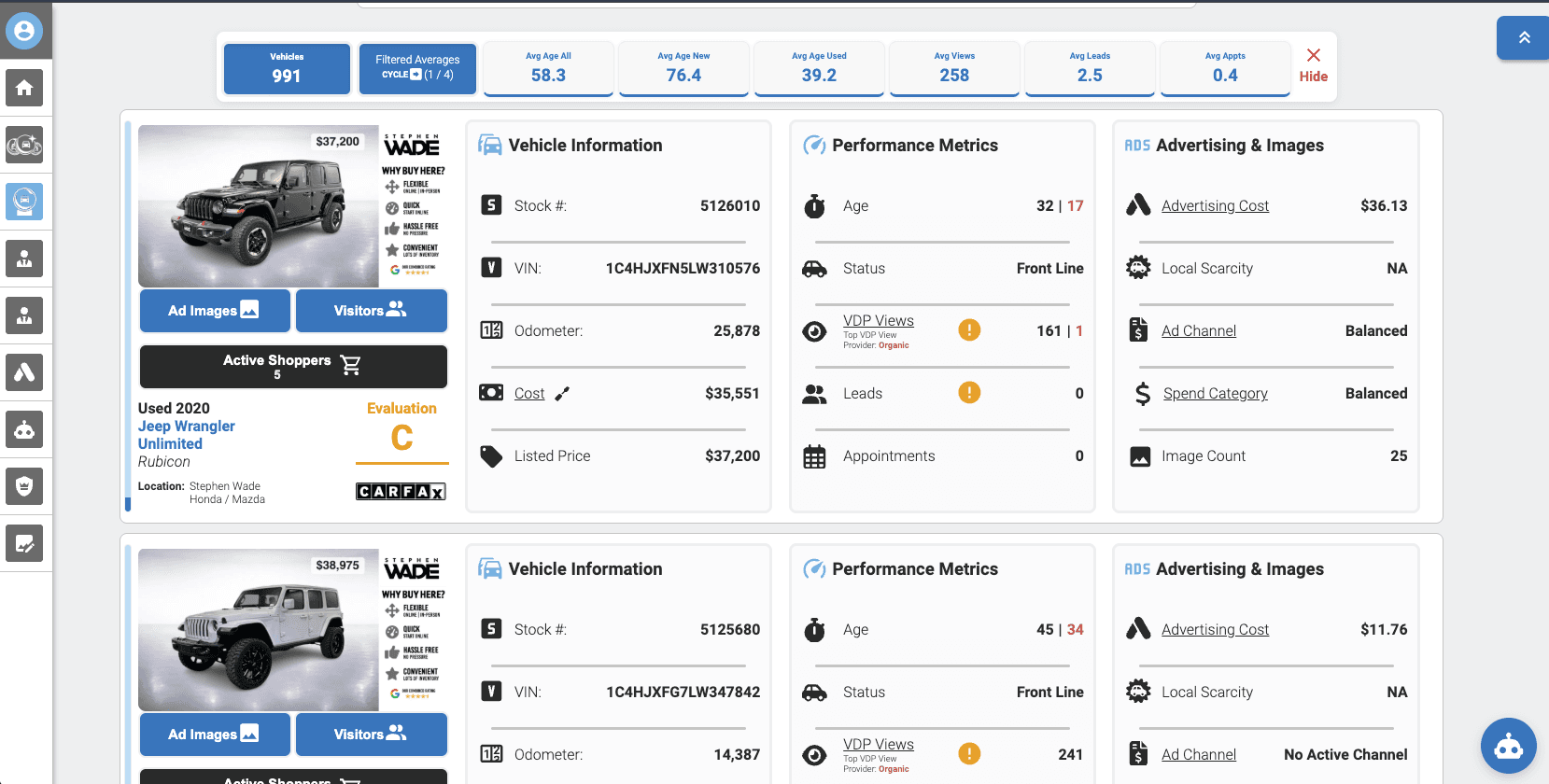
Carumai is a VIN-level inventory operating system. It reads your live inventory feed, every VIN, new and used, with age, price, status, VDP views, leads and active shoppers, and it judges each car against what it should be doing at that point in its life. The question is not "how old is this car" but "is this car getting the attention and inquiries it should have by now, at this price". Age is one input.
When a car needs help, Carumai assigns it a support level, Conservative, Balanced or Aggressive, with a daily budget for that car, and runs it on Google's display and inventory formats. When it does not, the car gets No Boost and no money. The reason is written on the car in plain language: this vehicle should have more views by this point; shopper activity has not produced inquiries; stock age is above expectation. Escalation is immediate when a car needs more help. De-escalation waits, so a car does not flicker on and off.
So the 12-day SUV with views and no inquiries gets advertising on day 12, with the reason on its card, and the car nobody asked about stops being invisible. The 65-day truck with active shoppers gets No Boost, and that reason is shown on its card. When an advertised car draws enough shoppers or enough qualified leads, or reaches its maximum advertising duration, its automated advertising stops and the reason is recorded and shown on the car. No car is advertised indefinitely.
Why each car is judged against itself
The reason for the per-car read is that averages do not hold from store to store. A six-month analysis of North American and European dealerships, written up in Digital Dealer in 2017, found that VDP views barely correlated with sales overall, and that the correlation varied from dealer to dealer, from none to mild; the author's advice was to verify the relationship on your own data rather than assume it (Noah John, "How Do We Know That VDP Views Matter?", Digital Dealer). A rule built on one assumption about what 60 days means is the kind of assumption that advice warns against.
The per-car read is on the VIN card: Stock Age and Merch-Ready Age, views, leads, appointments, active shoppers, with drill-ins by source, and the recommendation beside any override a manager has placed. The VIN Ads report shows, for any date range and store, every VIN advertised, for how long, at what cost, and its views, leads and age at start versus now. You verify the relationship on your own cars, every week, one row per VIN.
New cars are where the age line fails most quietly. Check the filter behind your aged campaign; if it was built on the used feed, new cars are not in it at all. Carumai reads new and used on the same terms and reports them separately. At a seven-rooftop dealer group running Carumai in August 2026, 1,319 cars were advertised and 38% of them were new, from the group's Carumai Scorecard, built from the weekly Listed and Delisted exports and the inventory pulls.
Keep your rule, add the engine
A store that wants every car past a line advertised writes that rule in plain terms as a manual channel, from a saved filter view: "60+ days on lot, new and used", pick the platforms (Meta, TikTok, Snapchat), set a geography and a monthly budget, and read the vehicle count before turning it on. The channel is labelled as the dealer's rule, never as the engine's pick, and its spend is reported separately, so the GM can see what the rule cost and what the engine cost. Rules in plain words covers how a store writes one.
A car that matches both the rule and the engine runs in only one channel, the one with the higher budget. No car is advertised twice. And a manager who disagrees with either can keep, change or stop a car's advertising with an override that expires, is recorded with who, when and why, and leaves the original recommendation visible beside it.
Monday with both
Carumai Daily arrives by email and text with the cars that need a decision: aged vehicles with demand, new and used listed separately, each with its VIN, age, leads, views, appointments and an Open button; blocked VINs with the exact reason; wholesale candidates. The aged list is still there, and beside it is the 12-day car, with the reason it is being advertised written on its card, and the 65-day truck that is not, with the reason it is not.
If you want to see it on your own inventory, bring one inventory export to a 20-minute demo and we will show you your zero-lead list and your coverage: book a 20-minute demo.
Frequently asked questions
What is the difference between aged inventory and underperforming inventory?
Aged inventory is any car past a fixed number of days in stock. An underperforming vehicle is one that is behind on views, inquiries or active shoppers for its age and price. A 10-day car can be underperforming; a 70-day car with active shoppers is aged but not underperforming.
Should a dealership advertise all cars over 60 days?
A store can, by writing that rule as a manual channel with its own platforms and budget, and Carumai labels it as the dealer's rule. The dealer's 60-day rule runs on every car that matches it. The engine's stops apply to its own automated advertising, and a car under 60 days with no inquiries can still start on the engine.
How does Carumai decide a car needs help before it is aged?
Carumai reads views, leads and active shoppers from the live inventory feed and compares each car to what it should be doing at that age and price. When a car is behind, it gets a support level and a daily budget, and the reason is shown on the car in plain language.
Sources
- Cox Automotive, "Used-Vehicle Inventory Edges Higher in July, but Affordable Options Remain Scarce," published August 14, 2026. https://www.coxautoinc.com/insights/used-vehicle-inventory-july-2026/
- Noah John, "How Do We Know That VDP Views Matter?", Digital Dealer, August 2, 2017. https://digitaldealer.com/dealer-gm/know-vdp-views-matter/