The report you build by hand
Open your CRM's lead report and read the column headers. Lead date, source, salesperson, status, vehicle of interest, last activity. The vehicle of interest is a year, make and model, sometimes a stock number. There is no column for how long that car has been on the lot. Now open your aging report. Stock number, days in stock, cost, price. There is no column for leads.
So the question a used car director asks on Monday, which of the cars past 45 days has never had a single inquiry, sits across two reports that do not share a column. The workaround is a spreadsheet: export the CRM leads, export the aging report, match on stock number, count. It is built by hand, and it is stale by Tuesday.
The shopper's side of that question is not small. The 2025 Cox Automotive Car Buyer Journey Study puts total shopping time at 13 hours 13 minutes, with 7 hours 11 minutes of it online (Cox Automotive, 2025 Car Buyer Journey Study). Every car on your website has been available through all of that time, for every buyer in your market. A car that has had no inquiry after 45 days of it is telling you something. The report that would let you hear it is the one you have been building by hand.
What Carumai puts on one row
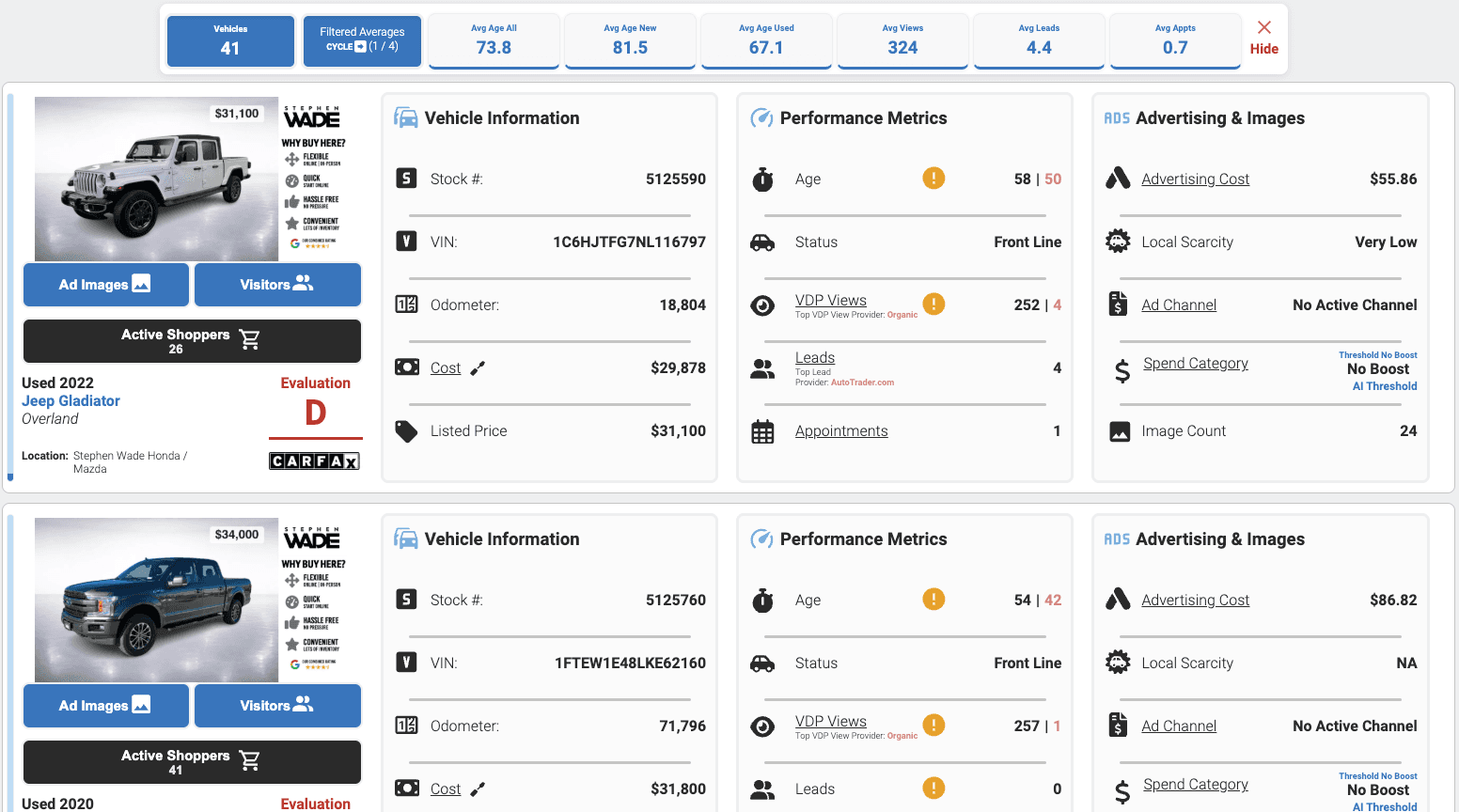
Carumai is a VIN-level inventory operating system. It reads your live inventory feed, every VIN, new and used, with age, price, status, VDP views, leads and active shoppers, and holds all of it on the car. The car is the row. The lead count sits beside the age on the same line, and so do views, appointments, advertising cost and the plain-language reason if the car needs help.
The Manager SRP is the workspace. Search by VIN or stock number. Filter by vehicle, by activity, by advertising, by price and cost, by evaluation and warnings. Set the activity filter to zero leads and the vehicle filter to the age you care about, and the list you have been building by hand is on the screen, live. The aggregate strip at the top shows the filtered count beside the dealership count, and the average age for all, new and used. Save the view and it is there next Monday with the current cars in it.
Open any car and the VIN card carries Stock Age and Merch-Ready Age, views, leads, appointments, advertising cost, the support level, Carumai's recommendation beside any override, the active channel and the warning with its reason. The drill-ins show views by source, active shoppers by source, and leads and appointments by source, so a car with views and no leads is a different card from a car with no views at all. Those are two different problems, and the car nobody asked about is the one the second card shows you.
For the spreadsheet people, the same read leaves the screen intact. Carumai's inventory export carries Views, Leads, Leads This Month, Active Shoppers, Appointments and Spend Level for every VIN. Sort by Leads ascending, and the zeros are at the top. Every metric on it has one definition, used everywhere in the product, so the number a manager sees on the card is the number on the export.
The zero-lead read, and coverage
Once leads sit on the car, one more column answers the question that follows: of the cars nobody has asked about, how many have advertising behind them right now? Spend Level answers it. Filter the front line to zero leads and read the count; add the advertising filter and read it again. The second against the first is your coverage: the share of front-line cars with no leads, on the day of the read, that have Carumai advertising behind them, used and new separately. The cars outside it are the walk list for the week.
At a seven-rooftop dealer group running Carumai, on September 1, 2026, 68 of 117 zero-lead used units and 80 of 141 zero-lead new units had Carumai advertising behind them, from the group's Carumai Scorecard, built from the weekly Listed and Delisted exports and the inventory pulls. Every zero-lead car without advertising shows why on its card: blocked at the readiness gate, judged not to need help (No Boost), stopped by a reached condition, or under a manager's override. Those are the cars a manager can name on Monday morning and decide about, one by one: price, photos, wholesale, or a rule of the store's own.
The reason the walk list matters is on the floor plan statement. Cox Automotive's 2017 worked example puts a dealer's holding cost at $1,071.15 per unit per month, or $44.63 per vehicle per day, and shows a 60-day turn consuming about $2,677 of a $3,000 gross (Cox Automotive, Three Floor Plan Finance Formulas Every Dealer Should Know). The formula is monthly holding cost divided by units in stock divided by selling days, and your own number will differ. The cost accrues on every car, and the cars with no inquiries are the ones with nothing pulling against it. A 70-day car with two active shoppers has a buyer in motion. A 30-day car with zero leads and zero views has nothing in motion, and it is the second car that leads by vehicle age puts at the top of the list.
What Monday looks like
The used car director opens Carumai Daily on his phone. The aged vehicles with demand section lists new and used separately, each car with its VIN, age, leads, views, appointments and an Open button. Blocked VINs are listed with the exact reason. One click goes to the car. Then he opens his saved zero-lead view on the Manager SRP, reads the filtered count against the dealership count, and walks the cars outside coverage with the desk. No spreadsheet.
At the end of the week, the Listed and Delisted exports give the GM the same story by VIN: every car advertised that week with its cost, impressions and clicks, and every advertised car that retail-sold. Carumai produces the weekly export a GM can read from the same definitions as the Monday screen, so the two never disagree.
If you want to see leads by vehicle age on your own inventory, bring one inventory export to a 20-minute demo and we will show you your zero-lead list and your coverage: book a 20-minute demo.
Frequently asked questions
How to find cars with no leads in dealer inventory?
Your CRM lead report and your aging report have to be matched by stock number in a spreadsheet, because neither carries the other's column. Carumai holds leads, views, active shoppers and spend level on every VIN beside its Stock Age, so a zero-lead filter on the Manager SRP lists them live.
What is zero-lead coverage in inventory advertising?
Zero-lead coverage is the share of front-line cars with no leads, on the day of the read, that have Carumai advertising behind them, used and new separately. Carumai's reporting states it for the store; a zero-lead view with the advertising filter on the Manager SRP shows the same cars, as does the Spend Level column on the inventory export.
Does a CRM show leads by vehicle age?
Open your CRM's lead report: the columns are lead date, source, salesperson, status and vehicle of interest. There is no column for the car's age, so the report cannot be grouped by it. Carumai reads the inventory feed and the lead count together and puts both on the car's VIN card and inventory export.
Sources
- Cox Automotive, 2025 Car Buyer Journey Study (research conducted fall 2025, released January 13, 2026). https://www.coxautoinc.com/insights/cox-automotive-car-buyer-journey-study-finds-efficiency-digital-tools-and-ai-drive-record-satisfaction/
- Cox Automotive, "Three Floor Plan Finance Formulas Every Dealer Should Know," July 25, 2017. https://www.coxautoinc.com/insights/three-floor-plan-finance-formulas-every-dealer-know/